Shaping Metal. Solving Problems.
If you’ve spent any time around fabrication, you’ve heard the debate:
TIG vs MIG welding.
Which one’s better? Which one’s stronger? Which one is right for the job?
At Starflex Fabrication, we work with both processes every day. And after decades of building real parts for real applications, we can tell you this:
It’s not about which process is “better.”
It’s about which process is right for the job.
Let’s break it down.
What Is MIG Welding?
MIG (Metal Inert Gas) welding uses a continuously fed wire electrode to create the weld.
In simpler terms:
- The machine feeds the filler metal automatically
- The weld happens fast
- The process is efficient and durable
MIG welding is known for:
✔ Speed
✔ Consistency
✔ Strong structural welds
✔ Production-friendly efficiency
That’s why MIG is often the go-to for:
- Sheet metal fabrication
- Thicker materials
- Structural assemblies
- High-volume production runs
When time matters — and it usually does — MIG welding keeps projects moving.
What Is a TIG Welder?
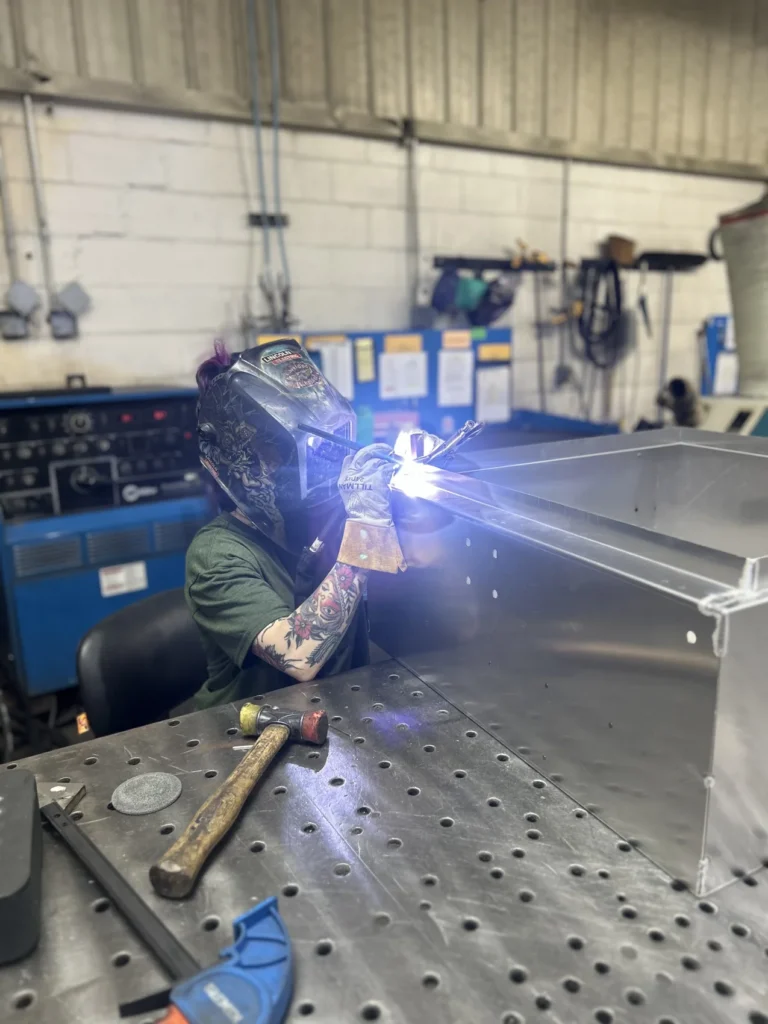
A TIG welder works differently.
TIG (GTAW/TIG welding – Gas Tungsten Arc Welding) uses:
- A non-consumable tungsten electrode
- A manually fed filler rod
- Much more operator control
A TIG welder isn’t just running a machine — they’re actively shaping the weld.
TIG welding is known for:
✔ Precision
✔ Extremely clean welds
✔ Minimal spatter
✔ Superior appearance
It’s the preferred process for:
- Thin-gauge metals
- Stainless steel
- Exotic materials
- Cosmetic/visible welds
And yes — TIG welding aluminum is one of its strongest applications when done by a skilled hand.
MIG vs TIG Welding: The Real Difference
When customers ask:
“What’s the difference between MIG and TIG welding?”
Here’s the honest answer.
MIG Welding
- Faster process
- More forgiving
- Ideal for thicker materials
- Excellent for production & structural work
- Lower labor cost
TIG Welding
- Slower process
- Requires higher operator skill
- Greater precision & control
- Best for thin/delicate metals
- Cleaner, more aesthetic welds
Neither replaces the other.
They solve different problems.
When TIG Welding Is the Right Choice
TIG becomes the clear winner when your project demands:
✔ Clean, beautiful welds
✔ High precision
✔ Thin materials
✔ Hygiene / sanitary standards
Typical TIG applications at Starflex:
- Thin-gauge steels
- Stainless steel components
- Aluminum parts
- Detailed/intricate weldments
Especially when:
✔ The weld will be visible
✔ Burn-through must be avoided
✔ Appearance matters
Tradeoff?
TIG is slower.
And slower means more labor time.
But when aesthetics and precision are non-negotiable?
TIG is worth it.
When MIG Welding Makes More Sense
MIG welding shines when your priorities are:
✔ Speed
✔ Strength
✔ Throughput
✔ Cost efficiency
Ideal MIG scenarios:
- Structural assemblies
- Thicker steel or aluminum
- Sheet metal fabrication
- Production runs
Because MIG uses continuous wire feed:
✔ Less downtime
✔ Faster weld completion
✔ Lower labor cost
For production environments?
MIG welding is almost always the smarter choice.
Speed, Labor & Cost Considerations
Let’s talk reality.
TIG vs MIG welding often comes down to:
Budget
Timeline
Volume
- TIG → slower → higher labor cost
- MIG → faster → more economical
That doesn’t make TIG “expensive.”
It makes TIG specialized.
And it makes MIG efficient.
Appearance vs Performance
Some projects demand flawless weld aesthetics.
Others demand:
✔ Structural integrity
✔ Strength
✔ Production speed
Weld appearance matters most when:
- The weld is visible
- The product is customer-facing
- Hygiene standards are critical
- Materials are thin or delicate
TIG wins here. Hands down.
Strength & throughput matter most when:
- Welds are structural
- Parts aren’t cosmetic
- Volume is high
- Schedules are tight
MIG takes the lead.
Can You Use Both TIG and MIG on One Project?
Absolutely.
Starflex does this when:
- Assemblies combine thin + thick materials
- Certain welds are cosmetic
- Efficiency and appearance both matter
It’s not unusual for a job to include:
✔ MIG for structural welds
✔ TIG for visible/detail welds
Right tool. Right place.
Quality, Fit-Up & Rework
An important distinction:
TIG welding is far less forgiving.
- Joint fitment must be precise
- Gaps can cause burn-through
MIG welding is more forgiving
- Better for less-than-perfect fit-ups
Finishing differences
TIG (done correctly):
✔ Often requires no cleanup
✔ Clean weld bead
✔ Minimal rework
MIG:
✔ May require slag cleanup
✔ Slight finishing depending on spec
What Really Determines Weld Quality
Regardless of process:
Skilled welders matter
Proper setup matters
Especially with TIG:
A TIG welder must understand:
- Heat control
- Filler timing
- Material behavior
MIG is easier to learn…
…but great MIG welds still require expertise.
How Starflex Chooses TIG vs MIG Welding
Most often?
The customer print dictates it.
If not specified:
Engineering + customer discussion
Select the best method for:
- Material
- Thickness
- Function
- Appearance
- Cost efficiency
No guesswork. No ego.
Just practical fabrication decisions.
Common Misconception
“TIG is just a stronger version of MIG”
Reality:
✔ TIG = Precision & control
✔ MIG = Speed & efficiency
Different strengths. Different jobs.
One-Sentence Takeaway
If we had to sum up MIG vs TIG welding:
MIG welding is faster and ideal for thicker materials and production work, while TIG welding delivers unmatched precision and appearance for thin or specialized metals.
The Starflex Difference
At Starflex Fabrication:
✔ Certified welders
✔ TIG & MIG expertise
✔ Real-world fabrication experience
✔ Fully integrated workflow
Laser cutting → forming → welding → finishing → assembly
Everything under one roof.
Everything built to spec.
Let’s Weld It Right the First Time (h2)
Not sure whether your project needs TIG or MIG welding?
That’s what we’re here for.
Contact Starflex Fabrication and let’s talk through:
- Materials
- Requirements
- Performance goals
- Budget & timeline
We’ll help you choose the right process — and get it done right. Contact Starflex Fabrication to get started on your next welding project today.