A Good Finish Can Hide a Bad Start
A freshly powder-coated metal part can look fantastic.
The color is right. The finish is smooth. Everything looks exactly the way it should.
But what happens six months later?
Maybe the coating starts peeling. Maybe bubbles appear around a weld. Or maybe rust begins spreading underneath a finish that looked perfectly good when it left the shop.
The problem may have started long before the powder was applied.
At Starflex Fabrication, we know that proper surface preparation is one of the most important parts of a successful powder coating job. It doesn’t matter how good the powder is or how carefully it’s applied if the metal underneath hasn’t been properly prepared.
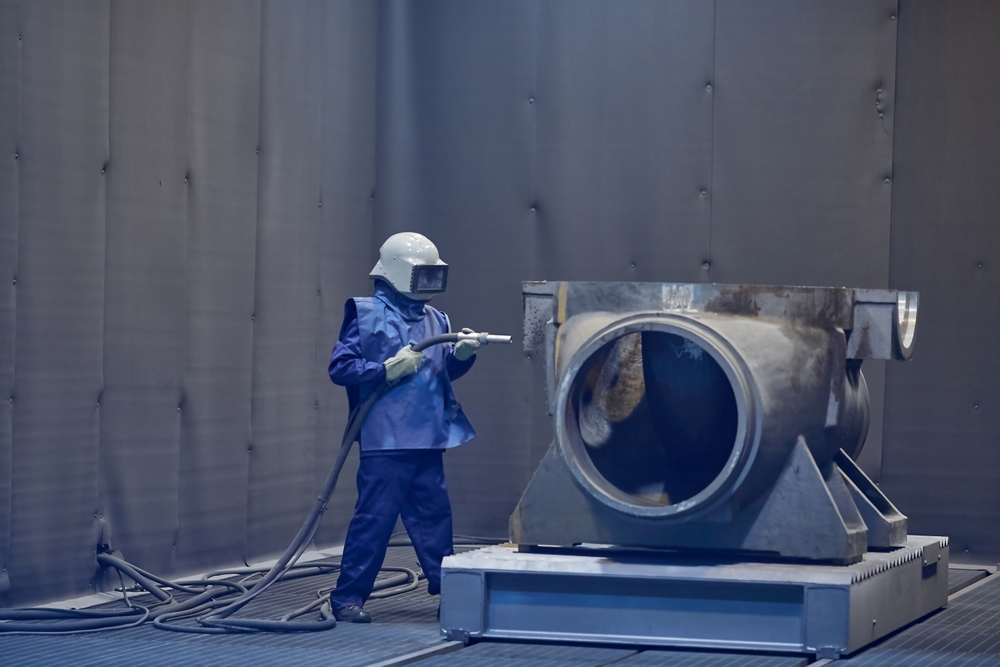
That’s why approximately 99% of our surface preparation involves abrasive sandblasting.
For the fabricated metal products we manufacture, sandblasting gives us an effective way to remove contaminants, prepare the metal for coating adhesion, and reduce the risk of problems down the road.
And because we handle fabrication and finishing under one roof, we can address many potential problems before they ever reach the powder coating department.
Why We Use Sandblasting for Powder Coating
Metal doesn’t always arrive at the finishing stage in the condition it needs to be.
Even a newly fabricated part can have mill scale, oxidation, welding residue, cutting fluids, grinding dust, oils, or other contaminants on its surface.
Some are easy to see. Others aren’t.
Either way, they can interfere with how well powder coating adheres to the metal.
There are several methods of powder coating surface preparation, including chemical cleaning and other powder coating pretreatment processes. Those methods can be effective for the right materials and applications.
At Starflex, however, we rely primarily on sandblasting for powder coating because it accomplishes two important things.
First, it mechanically removes rust, mill scale, oxidation, and other unwanted material that could compromise the finish.
Second, it creates a controlled surface profile.
That means the blasting process leaves behind microscopic peaks and valleys that give the coating a better mechanical foundation for adhesion.
This is particularly useful for fabricated carbon steel components, where mill scale, weld residue, and surface irregularities are common.
Blasting can also expose imperfections that might otherwise go unnoticed until after coating.
Of course, there’s a right and wrong way to do it.
Excessive blasting can damage thinner materials or leave a surface that’s too rough for the selected coating. The objective isn’t to blast every part as aggressively as possible. It’s to achieve the surface condition the job requires.
Surface Prep Starts in the Fabrication Shop
Imagine a fabricated part that’s ready to be powder coated, except for a few details that weren’t addressed during manufacturing.
There’s weld spatter on one side. A weld needs additional finishing. Several edges are sharp enough that the coating may not provide adequate coverage.
None of those issues necessarily means the part was fabricated incorrectly. But they can affect the quality of the finished coating.
Weld porosity and trapped contaminants can create another problem during curing, when escaping gases leave bubbles or pinholes in the surface. And because powder coating tends to be thinner along sharp edges, those areas can be more vulnerable to corrosion.
When the drawing and customer specifications allow it, we can address these conditions before coating begins.
Tight seams, inside corners, and recessed areas present their own challenges because they can make both preparation and uniform coating application more difficult.
These aren’t necessarily problems a powder coating operator can solve simply by applying more powder.
Sometimes the part needs attention before it reaches that point.
That’s why it helps to have fabrication and finishing working together. If something needs attention, we can address it before the part is coated instead of dealing with the consequences later.
That can save a lot of unnecessary rework.
Powder Coating Defects That Start Beneath the Surface
The tricky thing about poor surface preparation is that you might not notice a problem right away.
A part can come out of the coating process looking great. Then, after it’s been installed and exposed to normal operating conditions, things start going wrong.
You might see:
- Peeling or flaking where the coating hasn’t adhered properly.
- Bubbles or blisters caused by contamination or gases escaping during curing.
- Fish eyes, those small craters that can develop when contaminants interfere with the finish.
- Chipping that happens sooner or more easily than expected.
- Rust developing beneath the coating, sometimes spreading well beyond the original trouble spot.
And sometimes, the cause is something as simple as mill scale that wasn’t completely removed before coating.
The part may look fine initially.
But once it’s exposed to moisture and normal operating conditions, corrosion or separation of the underlying scale can begin undermining the coating.
Eventually, the finish may blister or peel away.
And once that happens, simply applying more powder isn’t going to fix the problem.
The defective coating generally has to be removed, the metal properly prepared, and the part coated again.
That’s a costly way to discover something was missed at the beginning.
Different Metals. Different Preparation Requirements.
There’s a reason we don’t treat every metal part exactly the same.
A carbon steel weldment with mill scale and surface rust is one thing. A piece of aluminum or stainless steel is another.
Abrasive blasting can be an excellent way to prepare carbon steel, but aluminum’s softer surface requires more care. Stainless steel needs protection against contamination that could affect its corrosion resistance, and galvanized steel presents additional concerns involving its zinc coating and possible outgassing.
Getting good results means understanding those differences and adjusting the preparation accordingly.
Where Will the Finished Part Be Used?
A part that spends its life in a clean, climate-controlled facility doesn’t have much in common with one that’s exposed to rain, road salt, chemicals, or constant handling.
At least not when it comes to finishing requirements.
Both might be good candidates for powder coating, but the preparation and coating system need to match the environment, especially when corrosion resistance is a concern.
That’s why we want to know where the part is going, what it’s going to encounter, and how long it’s expected to hold up under those conditions.
There are other details to work through, too. Does the customer need a particular color or texture? Are there threaded holes, mating surfaces, or tight tolerances we need to account for? Will the part’s shape make certain areas difficult to prepare or coat?
And sometimes, the answer is that powder coating isn’t the right finish for the job.
We’d much rather figure that out while we’re planning the work than after the part has been manufactured and coated.
Why In-House Fabrication and Finishing Matter
It’s much easier to fix a problem before a part is powder coated than after.
That’s one reason we like having fabrication and finishing under the same roof.
If something doesn’t look right, whether it’s a weld, an edge, or the condition of the metal itself, our team can take a closer look and work out what needs to be done.
We also have procedures and inspections in place to help keep the work consistent. That includes checking the surface before coating and performing additional quality checks when the job calls for them.
The less time we spend correcting problems after the fact, the more time we can spend getting the job done right in the first place.
And that’s better for everyone involved.
Quality Starts Beneath the Surface
It’s easy to appreciate a good-looking powder-coated finish.
What’s harder to see is all the work that went into making sure it stays that way.
Removing rust and mill scale. Cleaning up welds. Addressing sharp edges. Making sure the metal is properly prepared before the coating goes on.
Those details don’t necessarily stand out when you’re looking at the finished product.
But they can make all the difference in how well it holds up.
That’s why we take surface preparation seriously at Starflex, and why abrasive sandblasting plays such an important role in our finishing process.
Because the goal isn’t simply to deliver a part that looks good when it leaves Starflex.
It’s to deliver a part with a finish that’s prepared to perform in the environment where it will actually be used.
Have a metal fabrication project that requires powder coating?
Contact Starflex Fabrication to discuss your project and finishing requirements.